
Which Bike Generator is right for you?
There are 3 types of bicycle DC generators to choose from
Belt drive style - using a pulley and a belt around a rear bike wheel with the tire removed.
Rubber roller style - used on exercise bikes.
Metal roller style - which is driven by the rear wheel of a bicycle. No need to remove tire.
Belt Drive
Up to 300 Watts
Removal of back tire to be used
Already assembled version + Alone for a DIY platform (video asselmbly here)
Most cost-effective (generator alone)

All of our products are engineer built and come with a 1 year warranty and service plan. Lead time is typically 2-7 days, but contact us for a better estimate.
100% Human-powered Operation
This DC Generator can be driven by human power, wind power, or hydro. The 3/8" wide pulley has a 2 inch outer diameter. You will be able to mount this generator to a bike stand using an adapter mounting plate.
You can save more than 50% by making your own. Purchase a "MY1016" scooter motorand a 2" V-belt pulley 5/16" bore. Or you can this on Amazon.
It may be a big surprise, yes any DC permanent magnet motor also works as a DC generator. The MY1016 scooter is very robust engineered to operate in harsh conditions. It has ball bearings on its shaft as opposed to brass bushing bearings which are found in most cheap motors.
View PDF Data Sheet
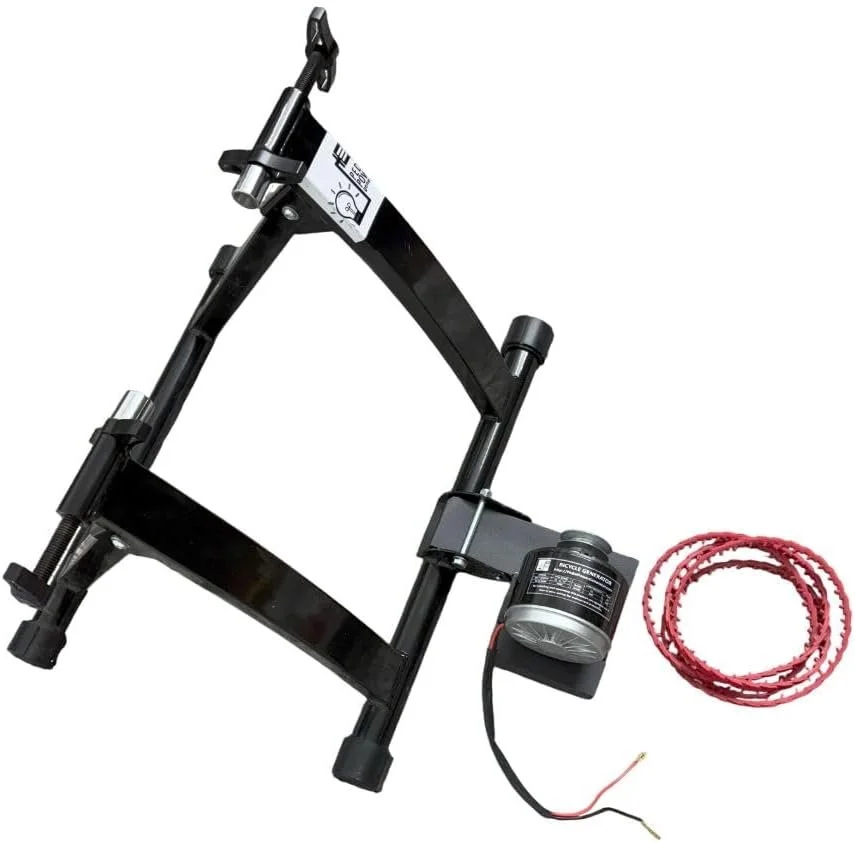
This product is designed, assembled, and tested in Gilbert Arizona. It comes with a lifetime warranty and service plan. Lead time is typically 1-8 days depending on inventory levels. Contact us for a better estimate.
The PPG-B300 Pedal Power Generator Belt Drive and Stand offers the flexibility to be used with either an adult full sized bicycle, or with a small child’s bicycle. This characteristic makes it the ideal solution for usage in a K- 12 classroom educational setting. It folds up and stores in a small location. It can be used for applications such as charging 12V Lead Acid Batteries, or 12V power packs because it puts out DC Voltage. For riders that can put out over 100 Watts, you will like the belt drive system because it has up to 40% more efficiency over a roller style generator system. (More details on this in the FAQ) You may take a look at the power output data by clicking on test results graphs shown.
FEATURES
Fits adults bike or kids bike (18″ wheels up to 27″ wheel size).
Able to charge 12V batteries
Alternative energy resource
Used for emergency power
Prepper bunker power
Great for classroom education
Fits adult bicycles
Drives 12V water pump
Drives 12V blender
Drives 12V air compressor
Charges portable power packs
Up to 300 Watts of power
Exericse Bike Generator - DIY

Scroll down for video
All of our products are engineer built and come with a 1 year warranty and service plan. Lead time is typically 2-7 days, but contact us for a better estimate.
100% Human-powered Operation
This generator allows you to make electricity by attaching it to the wheel of a bicycle or stationary exercise bike with a metal fly wheel. This DC Generator can be driven by human power, wind power, or hydro.
The 1" wide rubber drive roller 1.5 inch diameter. You will be able to mount this generator to a bike stand using an adapter mounting plate. Or you can mount this generator against the heavy fly wheel of a stationary exercise bike.
The graphs shown in the images are from actual data collected during a 1 hour period while charging a deep cycle 12V lead acid AGM battery. This is actually a permanent magnet DC motor. It may be a big surprise, yes any DC permanent magnet motor also works as a DC generator. This is a very robust engineered unit made to operate in harsh conditions. It has ball bearings on its shaft as opposed to brass bushing bearings which are found in most cheap generators.
Up to 300 Watts
Rubber roller: for exercise bike generators
DIY
Dual Generator
Up to 500 Watts
No removal of back tire
Already assembled version + Alone for a DIY platform
Highest Watts out of all our generators
Watch Demonstration Video Below
See Bigfoot Bike Generator Owner’s Manual (Instruction Manual) Here
View Bigfoot Product on Amazon
TIME TO CHARGE CELL PHONE: This bike generator takes the same amount of time to safely charge your cell phone as it takes when it charges while pluggede into wall charger. It is no different. For examplel it normally takes 30 minutes to charge with a wall adapter then it will take 30 minutes to charge with this bike generator system.
COUNTRY OF ORIGIN: This item is built in Gilbert, Arizona, USA. Some parts are made outside the US.
WARRANTY: This product has a lifetime warranty . NOTE: The warranty does not cover shipping charges.
SHIPPING: This item ships within 1 to 10 days depending on inventory (Call for an estimate)
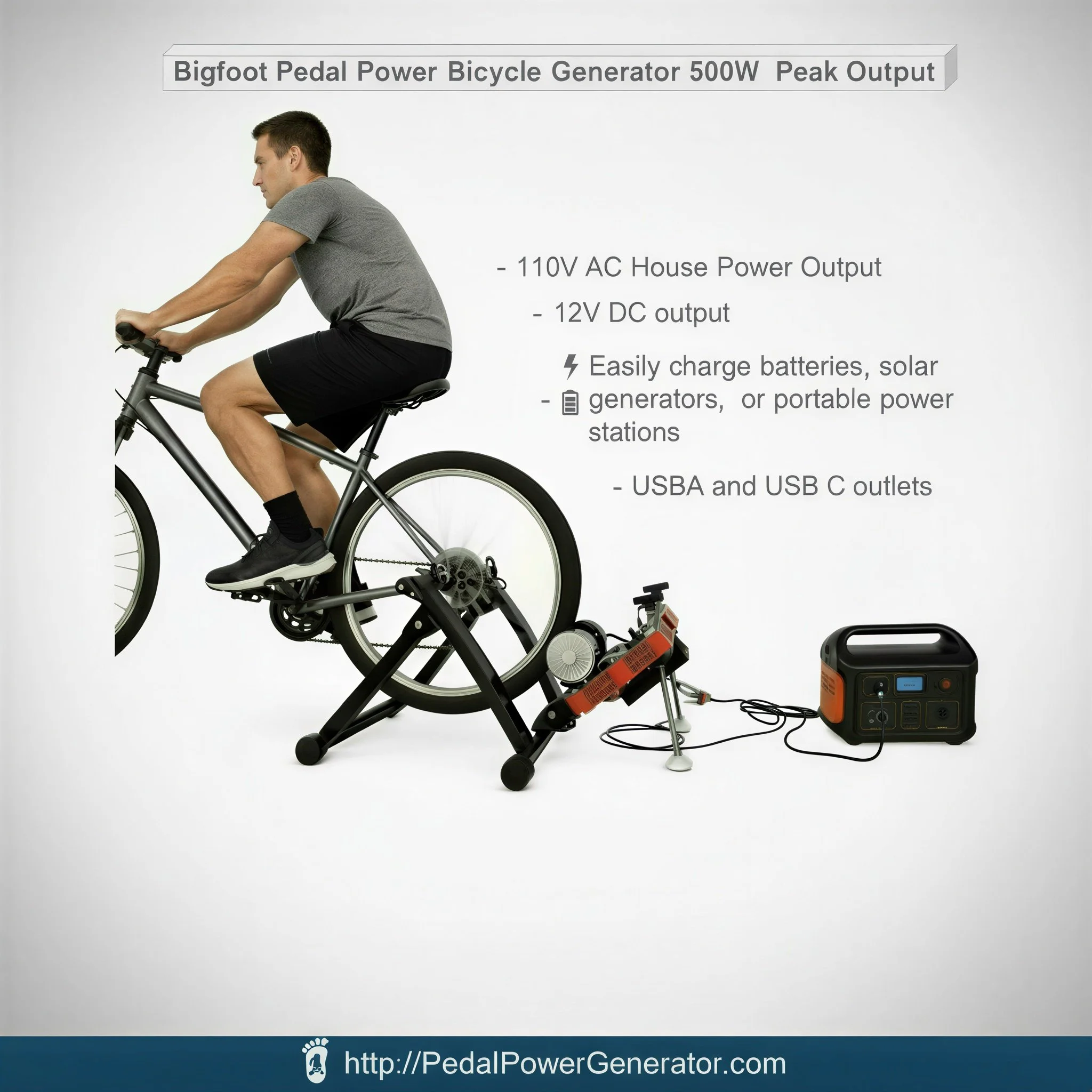
POWER OUTPUT TYPES: The Bigfoot™ is a pedal power bicycle generator system that has 5 types of power output:
110V AC House power
12V DC (Using built in voltage regulator)
USB C
USB A
Unregulated 0 to 80V DC
MAX POWER OUTPUT
The absolute peak power output of the Bigfoot™ bicycle generator is 500W. Typical output is 100 to 300 Watts depending on physical condition of the rider and what is being powered up.
KEY FEATURES:
Cell phones plug into the USB C or USB A charge ports located on the inverter
This bike generator systems includes two separate physical generators. They are wired together in two configurations: (1) Series connection allows Voltage to be 0 to 80V DC Output (2) Parallel configuration has Voltage range of 0 to 40V DC up to 20 Amps of current
Includes fuse with 20 Amps capacity
Adjustable Voltage regulator that has a default setting 14 Volts DC output (Same Voltage that a car operates at).
Digital power meter that shows real time data of Volts, Amps, Watts, and Watt hours
Able to charge a battery throug a blocking diode
Compatible with XT90 connector which is an industry standard for many companies. Almose any type of cable is available off the shelf with XT90 compatibilty.
THINGS THAT CAN BE POWERED FROM YOUR SYSTEM
A 12V screen display
Lights
Chargers for up to 10 cell phones at one time (5W each)
Blender
Wheat grinder
Laptop computer
Desktop computer
Water pump
Air compressors
HOW LONG DOES IT TAKE TO CHARGE A BATTERY
The data below is based on an assumption that you are an adult in good shape able to put out 100 Watts of power with a heart rate of 102 beats per minute. If the charg voltage is around 12V DC the output current will be 100 / 12 = about 8.3 AMPS. If your battery or portable powerstation / solar generator has a 20 Amp hour rating, then we can get the approximate charging time be dividing 20 / 8.3 = 2.4 Hours.
WHAT GEARS TO USE: Some people think that if they use the highest gear on a bike that they will put out more power. This is not always the case. Charging a battery is like climbing a hill on you’re your bicycle. When you go to climb a hill, you must shift down to lower gears to be able to pedal. Charging a battery is the same thing. So the answer is start with a lower gear and increment the gear level one at a time until you get the level your body feels comfortable putting out its maximum power.
SETUP INSTRUCTIONS: This system takes about 5 minutes to setup. Here are the steps:
Install a rear tire on your bike that has a small surface. This is to minimize frirction and noise and is most efficient.
Inflate your rear tire to its maximum allowed pressure plus 10%.
Open up stand and set it on the floor
Open up the clamping mechanisms on the stand that hold the back axle of your bike.
Lower the metal roller down to allow insertion of your bike
Set the bike onto the stand with help of a friend if possible.
Adjust the clamps such that the rear tire is centered on the metal roller.
Tighten the clamps down with approximately 20 ft-lbs of force – or as hard as you can with your hands without causing personal injury or pain in your fingers
Adjust the two large feet supporting the generator such that the generator is level and touches the rear tire.
Have some one look at the power meter on the generator face while you pedal the bike generator. At a casual pace the observer should see around 4 to 20 Volts DC on the power meter with no load attached to the output of the generator. If none is seen then contact us for help.
Connect your 12V battery or portable power station / solar generator
Get on the bike and pump your legs
Have some one watch the power meter in the back to verify that you are putting out power.

(Bike Stand Not Included)
All of our products are engineer built and come with a 1 year warranty and service plan. Lead time is typically 2-7 days, but contact us for a better estimate.
100% Human-powered Operation
The PPG-R500-SS dual DC generator dynamo is a robust ball bearing double generator connected by a rock solid 2inch x 3inch roller. This design is made to mount against the rear tire of a bicycle. The two generators can be configured end to end (series) to generate over 80VDC. The two generators can also be wired in parallel to supply twice the current as a single generator. This dual generator unit can reach an absolute maximum power of over 500 Watts (See data below) This unit can be mounted on a bike stand plate that adjusts the height of the roller to have good contact to the wheel as shown in the photo. You will note there are two graphs showing on the product images. The first graph shown indicates the absolute max peak power that can be reached during a 10 second burst of speed also known as a sprintinch hitting over 500 Watts. The PPG-R500-SS was wired in series mode for this experiment and connected to a 14 Ohm load. The second graph shows 1 Amp Hour of battery charging which took about 10 minutes of pedaling. In this case the PPG-500R-SS was wired in parallel configuration to allow more current to be delivered to the 12V deep cycle marine battery.
Contact us for the Data Sheet and Owner’s manual
Belt Drive and Rubber Roller Specifications


BENCHMARK / TEST DATA
This data was recorded using a WattsVIEW power monitor while charging a 12V Deep Cycle Duracell Battery Powerpack during a one-hour charging session.
For more information see the FAQ WEBPAGE. If you want to buy a generator stand ready to go out of the box then go HERE.
BENCH MARKING / TEST RESULTS

The data below shows actual data from a belt – pulley generator during a one hour bike riding session. Remember that Watts = Volts X Amps. So the 2nd chart below (green chart) is Watts which is simply the product of the red (Amps) and white (Volts) lines of the first chart.


What some people do not realize is that a DC bike generator dynamo can be used to charge a solar generator. The tricky part of it is finding out the maximum Voltage allowed into the solar generator and setting up your generator so that it DOES NOT EXCEED that maximum Voltage. An easy way to find this out is to opne a search on Amazon or Google or your favorite search enginer and type the model of the solar generator along with the words Specifications PDF. Then look for Input charge Voltage There are three ways a pedal power bicycle generator can be configured to charge a solar generator :
If you do a search for the phrase “Solar Generator” you will see hundreds of options like these shown HERE. A solar generator is just a fancy name for a (usually Lithium) battery portable power station that has a built in charge controller that can handle a wide input Votlage from a solar panel. A normal portable battery powerpack power station just takes a 12V DC input.
OPTION 1 – A single 300W PPG-R300 or 300W PPG-B300 generator will put out a max Voltage of about 50VDC. So to be safe you would do a search for a solar generator that could handle a charge OCT or maximum input Voltage of 60V DC or higher and connect your bike generator to it. HINT: The higher the charge Voltage then the higher the cost of the solar generator. An example of a high input Voltage For example the 1500WH Bluetti Maxoak can handle a max input charge Voltage of 68VDC. It costs $799. If you go with a two way dual 500W generator it can hit a peak of 100V DC so you would need something like the Bluetti AC200 Max that can handle a max input charge Voltage of 145V DC. This costs $1,899
OPTION 2 – Use a much less expensive solar generator along with an over Voltage protection module.

This will open up the connection between the bike generator and the solar generator power station whenever you start to pedal too fast and exceed the max Voltage of your solar generator. For example I purchased the FlashFish 200W for $129.00. It has a lot of power for such a small size. It takes a max input charge DC Votlage of 24V. To protect it from being damaged by the bike generator I installed an NC25A-12V unit which opens up the relay connection at about 16V DC When pedaling at 50V DC Output on the bike generator. The reason why the NC25A is so special is that handles a max input Voltage of 140V DC so that when it opens up to protet your solar generator it does not get destroyed by a huge Voltage spike. This means the Voltage going into the FlashFish will never go over 16V DC.